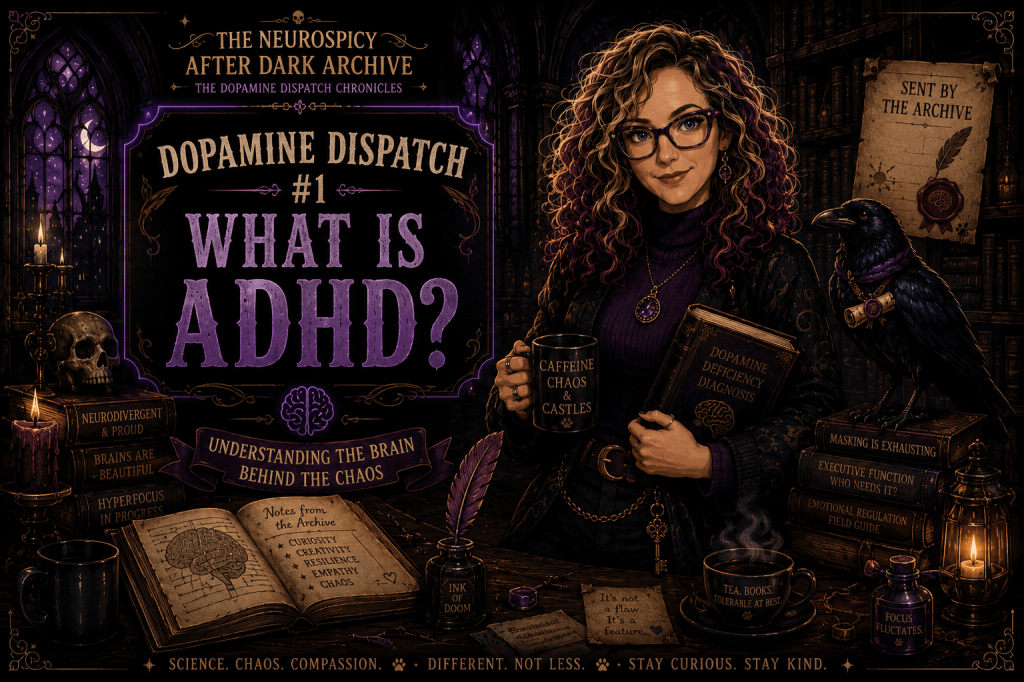
So, we’ll start at the very beginning with our first offical dispatch and answer the basic questions.
ADHD stands for Attention Deficit Hyperactive Disorder.
ADHD is a neurodevelopmental disorder that affects how the brain regulates attention, impulse control, activity level, organization, and executive functioning.
Symptoms begin in childhood, important to point out however many people are not diagnosed until adolescence or adulthood especially females. ADHD is not simply a lack of attention, it is a difference in how the brain manages attention, motivation, self-regulation, and task management.
ADHD symptoms fall into three main categories:
#1 – Inattention
Examples can include but are not limited to:
– Have difficulty sustaining focus
– Become easily distracted
– Struggle with organization
– Frequently lose items
– Forget appointments or tasks
– Have trouble following multi-step instructions
#2 – Hyperactivity
Examples can include but are not limited to:
– Feel restless or “driven by a motor”
– Fidget or move frequently
– Talk excessively with absolutely no filter at most times
– Have difficulty sitting still for long periods of time
Sidenote: In adults, hyperactivity often appears as internal restlessness rather than obvious physical activity. This leads many to experience generalized anxiety that waxes and wanes. These people are commonly diagnosed with an anxiety disorder and not screened for ADHD consistently at present time.
#3 – Impulsivity
Examples include:
– Interrupt conversations
– Act before thinking
– Have difficulty waiting their turn
– Make quick decisions without considering consequences
– Impulse shopping i.e. incurring large debt
– Binge eat, drinking, drugs, etc
Diagnostic criteria have evolved across DSM editions (DSM-III, DSM-III-R, DSM-IV, DSM-5) with evolving subtypes and specifiers, reflecting advances in clinical and neurobiological understanding
Notably, DSM-5 situates ADHD within the Neurodevelopmental Disorders section and specifies presentations based on predominant symptom clusters, while earlier DSM iterations varied in how they categorized and labeled subtypes.
Cited sources: ADHD description as a neurodevelopmental, neurobiological condition; symptom triad; DSM history and evolution (Contreras et al., 2019), (Botero-Franco et al., 2016), Miguel (n.d.), García, 2005), (Miguel, n.d.)
ADHD can present in three ways:
1. Predominantly Inattentive Presentation (formerly called ADD)
2. Predominantly Hyperactive-Impulsive Presentation
3. Combined Presentation (both inattentive and hyperactive-impulsive symptoms)
*I will discuss more on each subtype in a further dispatch*
Although ADHD is lifelong, its begins at childhood or even infancy (we don’t know, but it does have a genetic factor, so it is there from birth), many adults continue to experience symptoms or were never recognized as children to have ADHD due to masking i.e. usually a female (a topic for another post).
Adult ADHD often shows up as:
– Difficulty managing time (“time-blindness”)
– Chronic procrastination (Executive Functioning)
– Trouble starting or finishing tasks (task initiation or follow-through)
– Forgetfulness or absentmindedness
– Lack of attention to detail
– Emotional dysregulation
– Extreme sensitivity to rejection (or RSD)
– Relationship challenges (boredom after novelty)
– Workplace difficulties i.e. getting bored after the initial novelty has worn off)
If you think you are having trouble functioning as an adult, have had more jobs then you can count, you bounce from topic to topic, struggle with relationships, have severe mood swings that are quick, you might have ADHD, and most importantly if you think you have ADHD, then consult your PCP for a referral to see a psychologist or psychiatrist for referral.
Researchers do not know one single cause and it has many different theories currently being researched, but the generalized consensus on the cause is that ADHD is strongly influenced by:
– Genetics (it often runs in families)
– Differences in brain development and function
– Environmental factors that affect brain development
It is what we call “multi-factorial.”
Simply put it has many factors that contribute to it.
IMPORTANT: ADHD is not caused by laziness, poor parenting, lack of intelligence, or lack of willpower.
ADHD is not something to be cured. There are treatments that help us manage in a world that is not designed for support of this condition.
ADHD is not a disease, it isn’t even a disorder in my opinion. It is a difference in a world not wired for different. A world that does not treat difference with respect but with shame and judgement.
If nobody has told you today, let me be the first:
Your brain isn’t broken. It isn’t lazy. It isn’t “too much.”
It’s simply running a different operating system…one that’s capable of incredible creativity, pattern recognition, resilience, humor, and ideas that somehow connect twelve unrelated topics before breakfast.
Some days that operating system crashes after opening one email.
Other days it hyperfocuses for six hours because you had to know how medieval monks made ink. (I get it, trust me. I know how the medieval monks made ink.)
Both days are valid. You are valid.
I firmly believe that the more we understand neurodivergence through science, through lived experiences with one another, with open minds and hearts instead of hate & stigma, the easier it will become to replace shame with self-compassion and acceptance.
So drink some water. Eat the snack you’ve been ignoring. Unclench your jaw & drop your shoulders. Save this post for your future self who will absolutely forget it exists. (It’s okay… I probably will too.)
Until next time…
Stay Neurospicy. Stay curious. Be kind to your wonderfully weird brain. May your dopamine arrive before your deadlines.
— Dr. Neurospicy, MD
Archive Curator
The Dopamine Dispatch Chronicles is intended for educational and informational purposes only and is not a substitute for professional medical advice, diagnosis, or treatment.
The information shared reflects current scientific literature, reputable medical resources, and, at times, personal perspectives. It should not be used to diagnose yourself or anyone else, nor should it replace an evaluation by a qualified healthcare professional.
If you think you may have ADHD or another neurodevelopmental condition (or if you have questions about your physical or mental health) please schedule an appointment with your primary care provider (PCP) or another qualified healthcare professional. They can help determine whether further evaluation, testing, or treatment is appropriate for your individual situation.
If you are experiencing a medical emergency or are concerned that you may be in immediate danger, call your local emergency services or go to your nearest emergency department.
If you enjoyed this dispatch, I’d love to have you in the archive.
📖 Subscribe to the Neurospicy After Dark Archive so you never miss a new Dopamine Dispatch Chronicle, book review, or neurodivergent deep dive.
🔗 Follow along through my Linktree for Instagram, Facebook, Pinterest, TikTok, and everything else I’m inevitably hyperfocusing on this week.

💬 Have a topic you’d like covered? Visit the Contact page on the blog and send me your questions, ideas, or neurospicy rabbit holes you’d like us to explore together.
Because the best archives aren’t built by one librarian…they’re built by a whole community of beautifully chaotic minds.


Leave a Reply