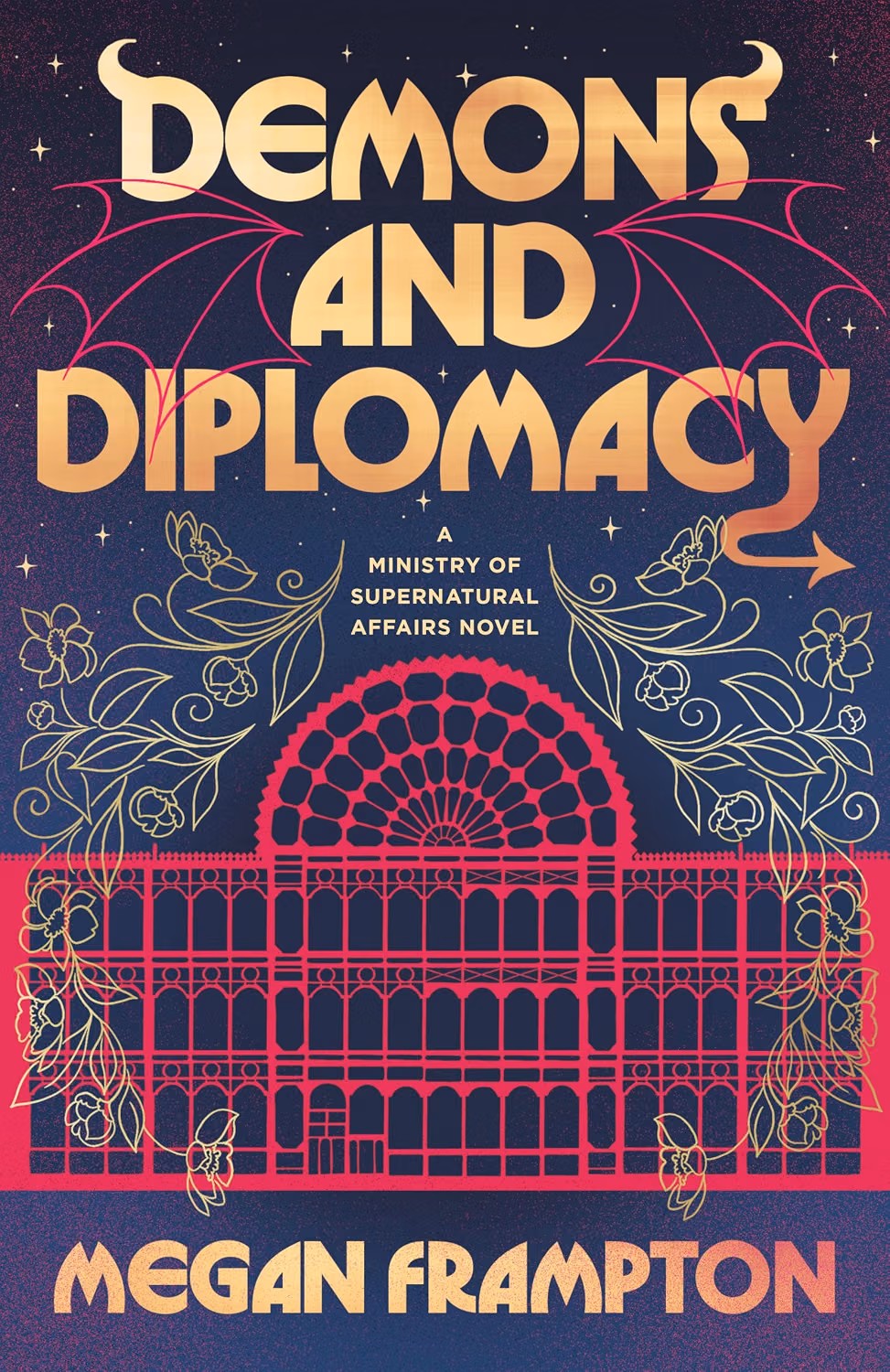
Title: Demons & Diplomacy
Author: Megan Frampton
Genre: Paranormal Romance
Subgenres: Alternate Historical Romance | Gaslamp Fantasy | Supernatural Romance | Demon Romance | Political Intrigue | Historical Fantasy
⭐️ My Rating: 4/5
🌶️My Spice Rating: 3/5 – open door romance with substantial supernatural heat
Publication Date: August 25th 2026 –> Out Now!
(Yes, I know this is late, ADHD paralysis w/severe executive dysfunction and Emergency Medicine Physician Residency…has my life chaotic… I did read it by August 25th but finishing this review to my standards has been time consuming.)
- Human FMC × demon MMC
- The Devil’s dangerously charming son
- Forbidden supernatural romance
- Reluctant allies & uneasy alliance
- Forced proximity
- Opposites attract
- Competence kink
- He sees straight through her
- Political intrigue and conspiracy
- Victorian alternate history
- Supernatural society
- Seductive banter
- Saving the world together
- “Making a deal with the Devil” — almost literally
- Powerful, perceptive MMC
- Independent, capable FMC
- Diplomacy with benefits
Potential content includes:
- Supernatural violence
- Threats of mass violence
- Political conspiracy
- Danger
- Demonic imagery
- Religious themes
- Prejudice and discrimination between species
- Manipulation
- Power imbalances
- References to Hell and the Devil
- Coercive political circumstances
- Sexual content
As always, content sensitivities are highly individual, so I recommend checking the author’s complete warning list before reading. Your mental health matters more than reading a book, please do not force yourself.
In an alternate version of Victorian London, supernatural beings no longer hide in the shadows. Following the Great Revelation, the British Empire is ruled by the vampiric Queen Victoria (hehe, I loved this) and her dhampir consort, Prince Albert…and humans must now share their society with vampires, shifters, demons, and other supernatural species. Oh, the absolute horror…
Cora Hastings is the British government’s “Species Ombudsman”, an ordinary human responsible for resolving decidedly extraordinary disputes. Whether she is negotiating contracts between supernatural factions, enforcing new shifting regulations, or attempting to ensure that every species receives equal treatment, Cora has built her career around maintaining a fragile peace.
Then the Devil announces that he wants to visit London for the opening of the Great Exhibition.
As if entertaining the ruler of Hell were not politically hazardous enough, the Devil brings along his son: the Marquis of Hell. He is devastatingly attractive, unnervingly observant, and equipped with precisely the kind of silver tongue one would expect from infernal royalty.
When Cora discovers evidence of a conspiracy surrounding the Exhibition, she must decide whether she can trust the demon assigned to complicate her life. Forming an alliance with the Devil’s son may be the only way to save London—but bargains with Hell rarely come without consequences.
Demons & Diplomacy had me at “vampiric Queen Victoria,” but adding an overworked civil servant, supernatural bureaucracy, a politically inconvenient demon, and a conspiracy at the Great Exhibition made this feel specifically engineered to hijack my dopamine receptors and give me that much needed dopamine hit. Happy to say, it certainly worked for me.
This story combines historical romance with imaginative paranormal worldbuilding and political intrigue. The supernatural elements are not simply decorative (thank god for that, as it could have gone that direction); they are integrated into the laws, social structures, prejudices, and administrative complications of this alternate Britain. Apparently, even after revealing the existence of vampires and demons, society’s first response is still to create regulations and assign an exhausted woman to enforce them.
Honestly? Believable. The book’s greatest appeal is the contrast between Cora’s practical, methodical approach and the Marquis’s seductive, morally flexible energy. She is trying to prevent an international—or possibly interdimensional—incident. He appears uniquely qualified to become one.
Cora is exactly the kind of heroine I enjoy: intelligent, capable, observant, and forced to perform emotional labor for an entire society that probably does not appreciate her nearly enough. My readers, I feel like Cora lately…won’t lie to you. It is probably why I liked her so much.
As Species Ombudsman, she occupies an uncomfortable position between humans and supernatural beings. She is expected to remain impartial while negotiating disputes shaped by fear, prejudice, and unequal power. Her humanity could easily make her seem insignificant beside creatures with supernatural strength and centuries of experience, but her authority comes from her intelligence, persistence, and ability to understand competing perspectives. She is capable, no nonsense take no prisoner type of woman and I loved that about her.
Her competence is one of her most attractive qualities. Cora does not need magical powers to become essential. She understands systems, recognizes inconsistencies, and knows when someone is attempting to manipulate a negotiation. For me I felt that her work reveals a strong moral center i.e. she is not merely protecting government interests but trying to ensure that different species are treated fairly. I love this, it really appealed to my justice sensitivity.
At the same time, her sense of responsibility can become a burden and I felt that while reading the book. To me she is accustomed to managing conflict, anticipating consequences, and controlling her reactions but when she meets the Marquis and wants to explore even subconsciously a new relationship, she hoists a deep sense of responsibility upon her shoulders. That makes the Marquis particularly disruptive because he notices more than she wants him to and he refuses to remain conveniently categorized as either a diplomatic assignment or an obvious enemy.
The Marquis is dangerously charming in the way only a demon with excellent conversational skills and questionable intentions can be. He was delicious to me from the start. I do love me a competent, bad boy MMC.
He is beautiful, confident, unnaturally perceptive, and in my honest opinion…entirely too comfortable testing Cora’s composure. I appreciated that his overall appeal does not rest on physical attractiveness alone. He watches, listens, and identifies the things other people try to conceal. That perceptiveness gives his interactions with Cora an intimate edge even before their physical relationship develops.
There is an entertaining tension between what Cora assumes a demon must be and what the Marquis actually reveals through his choices. He belongs to Hell’s ruling family and carries all the dangers associated with that position, but he is not a one-dimensional embodiment of evil, the dude has him some layers and Cora is perplexed when she started to realize it, I enjoyed that aspect of the plot alot. His intelligence, humor, curiosity, and shifting motivations make it difficult for Cora (read: the reader) to decide exactly how much he can be trusted.
He brings temptation, power, and moral ambiguity into every scene but to me more importantly, he respects Cora’s mind. He does provoke her relentlessly, but he does not treat her humanity as a weakness or her professional authority as irrelevant. For a literal demon, the bar may be located somewhere beneath the Earth’s crust, but he clears it with considerable style.
Cora and the Marquis have the kind of chemistry built on verbal sparring, mutual observation, and the growing realization that each has finally encountered someone capable of keeping up.
I felt that their attraction works because it is tied to more than proximity or physical appearance. Cora is fascinated despite every rational argument telling her that trusting him is a terrible idea. The Marquis, meanwhile, is drawn to her intelligence, restraint, courage, competence and her absolute refusal to be overwhelmed by his title or supernatural power.
I loved that their conversations carry multiple layers i.e. diplomacy on the surface, flirtation underneath, and strategic calculation woven through both. Every exchange feels like a negotiation in which neither participant intends to reveal how much they actually want one another.
I loved that the Marquis challenges Cora’s rigid sense of control, while she challenges his assumptions about ordinary humans. I firmly believe that relationships, especially romantic partners, should challenge and make one another better.
He may possess infernal power, but Cora brings the judgment and practical intelligence necessary to use that power effectively. Their strengths complement one another, creating a partnership that feels balanced even though their supernatural abilities are anything but equal.
Cora and the Marquis Together
The relationship develops within an atmosphere of uncertainty. Cora cannot separate the Marquis from the political danger represented by his father, and she cannot afford to forget that demons are associated with bargains, manipulation, and hidden costs. Trusting him is not just an emotional risk—it could have consequences for Britain’s entire supernatural population.
That external pressure gives their romance additional weight. Each step toward intimacy requires Cora to reassess her assumptions about him, while the Marquis must prove that his interest extends beyond amusement or temptation.
Their alliance also allows both characters to be appreciated for what they contribute. Cora possesses institutional knowledge, diplomatic experience, and an understanding of London’s supernatural tensions. The Marquis has access to infernal power, insider knowledge, and a willingness to operate outside polite human rules. Together, they become far more effective—and substantially more dangerous—than either would be alone.
The result is a relationship fueled by temptation but strengthened by respect. The heat is delicious, but the intellectual compatibility is what makes the pairing memorable.
Megan Frampton’s writing balances historical atmosphere, paranormal creativity, humor, romance, and danger without allowing any single element to overwhelm the others.
The alternate Victorian setting feels playful but purposeful. It was certainly the first bit in the description that sold me on the read. I loved that familiar historical figures and events are reimagined through a supernatural lens, while bureaucratic details help make the world feel lived-in. The Great Exhibition provides an especially effective backdrop because it already represents ambition, innovation, spectacle, and imperial power. Adding supernatural diplomacy and a conspiracy I felt really turns that historical setting into a pressure cooker.
The prose has a witty, accessible quality rather than feeling overly formal or burdened by historical detail. The dialogue is particularly effective during Cora and the Marquis’s exchanges, where political negotiation frequently becomes flirtation before either character is willing to acknowledge it.
There is a significant amount of worldbuilding, but much of it emerges through Cora’s work. Her position offers a natural way to introduce laws, supernatural groups, and political conflicts without making the information feel completely detached from the story.
- The alternate-history premise: A vampiric Queen Victoria and supernatural Great Revelation immediately distinguish this world from a standard Victorian romance.
- Cora’s professional role: Making the heroine a Species Ombudsman gives her meaningful authority and places her at the center of the political conflict.
- Competence-based attraction: The Marquis is interested in Cora’s intelligence and composure, not merely her appearance.
- The Banter: Their verbal exchanges combine flirtation, strategy, and mutual testing.
- Supernatural bureaucracy: Regulations governing shifting and interspecies agreements are clever details that make the world feel functional.
- The power balance: Cora may be physically ordinary, but the relationship does not treat her as insignificant.
- Romance with an actual plot: The conspiracy provides stakes beyond whether the characters will admit their attraction.
- The moral ambiguity: The Marquis is alluring because his intentions cannot be reduced to purely good or purely evil.
- The historical setting: The Great Exhibition creates a visually rich and politically charged backdrop for the conflict.
The ambitious combination of historical romance, paranormal worldbuilding, political conspiracy, and supernatural social policy means the story sometimes has a great deal to manage at once. It was handled well but there were some areas where details were confusing or just glossed over towards the end, certainly it did not detract from the overall read.
In addition, I wanted a little more space in certain moments for the emotional consequences of Cora’s choices to settle. Sometimes she was a little blasé or too quick to accept, I think she might have needed more time to cope and adjust.
The banter and external danger keep the story moving, but a few quieter scenes could have allowed the vulnerability beneath Cora’s and the Marquis attraction to breathe and solidify more.
Finally, some of the species’ politics I felt simplified extremely complicated questions of prejudice, integration, and power.
- This is a genre blend rather than a conventional historical romance.
- The paranormal worldbuilding and political plot receive substantial page time.
- The humor exists alongside genuine threats and supernatural danger.
- The romance involves a human woman and a powerful demon, so questions of trust and unequal power are part of the dynamic.
- The story plays creatively with historical people and events rather than attempting strict historical realism.
- Readers who enjoy banter, competence, conspiracies, and morally ambiguous supernatural love interests will likely have the best time.
- If your favorite phrase is “historical accuracy,” the vampiric monarch may require you to temporarily unclench.
My Final Thoughts
Overall, I felt that Demons & Diplomacy is a clever, seductive mixture of Victorian history, supernatural politics, conspiracy, and infernal romance. Cora is a highly competent heroine whose intelligence allows her to stand toe-to-toe with monsters, monarchs, and government officials. The Marquis of Hell is charming, perceptive, morally complicated, and he is exactly dangerous enough to make trusting him an irresistible but unavoidable mistake.
Their relationship delivers wit, temptation, and mutual respect, while the alternate-history setting gives the central romance a distinctive identity. Although the number of genres and political threads occasionally makes the story feel crowded, its creative premise and central chemistry kept me invested.
Come for vampiric Queen Victoria and supernatural bureaucracy. Stay because a chronically responsible and competent woman is trying to prevent Hell from breaking loose while the Devil’s devastatingly attractive son flirts with her during official government business. I know you will not be disappointed.
Apparently, diplomacy requires tact, patience, and occasionally making out with the opposition.
ARC Review Disclaimer
I received an advance reader copy of Demons & Diplomacy by Megan Frampton. I am posting this review voluntarily. All opinions expressed here are entirely my own. Receiving an ARC did not influence my rating or commentary.
Archive Status
Filed Under: Infernal Diplomacy, Supernatural Bureaucracy & Demons Who Have Never Respected Professional Boundaries
- Case Status: Officially declassified, spiritually compromised, and still under investigation
- Dopamine Verdict: Highly recommended for readers who enjoy competent heroines, seductive negotiations, paranormal politics, and men who are walking red flags—but make them infernal royalty
- Prescription: One morally questionable alliance, taken with sharp banter and absolutely no expectation of maintaining professional distance
- Potential Side Effects: Sudden interest in Victorian supernatural policy, inappropriate sympathy for demons, and the firm conviction that diplomacy would be easier if everyone simply admitted they wanted to kiss.
- Archive Shelf: Historical Romance After Dark: Between Bureaucracy, but Make It Sexy and This Is Why We Read the Fine Print
Ways to Follow the Dopamine
Want more spoiler-free ARC reviews, morally questionable fictional men, neurodivergent bookish chaos, and romantic decisions that would never survive peer review?
Follow The Neurospicy After Dark Archive on:
- Instagram: Reviews, carousel breakdowns, trope reveals, and aesthetic bookish chaos
- Facebook: New reviews, blog posts, discussions, and Archive announcements
- Pinterest: Review graphics, reading inspiration, mood boards, and romantically questionable visual evidence
- The Blog: Full-length reviews, character deep dives, monthly reading ledgers, and every thought too elaborate to fit inside an Instagram caption
- Linktree: Your central portal to the complete Archive and all its delightfully unregulated wings
Follow along, share your current read, and tell me which fictional red flag has most recently disrupted your executive functioning.
Until Next Time…
This is Dr. Dopamine After Dark, MD, the Curator of the Neurospicy After Dark Archive —today’s prescription s/p archiving is one infernal alliance with meals, sharp banter as needed, and strict instructions to read every demonic contract before becoming distracted by the Marquis’s face. Side effects may include supernatural hyperfocus, diplomatic misconduct, and the sudden belief that “hellishly attractive” is a perfectly valid character reference.
 The Neurospicy After Dark Archive
Leave a comment